Camping with your dog can be extremely rewarding and tons of fun, as long as you prepare properly for the trip and remember to be considerate of your dog and others on the trails.
Preparing for the Trip
Call ahead and find out if your desired destination allows dogs. Even if you have been to a particular campsite before with your pooch, a bad dog experience and irresponsible owners can cause parks to change their rules. Also, find out the location and phone number of the nearest 24 hour vet.
Once you have ascertained that your dog is welcome, if possible, take your dog to the site a couple of times before you head out for a camping trip. Your dog will be more relaxed and comfortable if the location is familiar. If you intend to take a separate tent for your dog, set it up in your house or yard for a few days and let your pup check it out. He will be a lot more likely to consider the tent a safe getaway if he has had a chance to get used to its presence and smell. You should do the same with any other equipment for your dog. If he is going to be carrying a pack, take him for several walks with the pack to make sure he is comfortable with the added weight. If you’re bringing booties or a light up collar, try these out on him before the trip as well. In the event that you dog is not going to take well to his new equipment, you’ll want to know before you’re out on the trail.
Before you leave, make sure your dog is up-to-date on all his vaccinations. If possible, take him for a well checkup before you hit the road, and make sure you obtain copies of his records. Also, make sure your dog is covered as far as flea and tick treatment, and consider the Lyme disease vaccine if you’re going to a heavy tick area. If your destination is a popular hangout for mosquitoes (coastal areas, marshlands, anyplace with a lot of standing water) your pooch should be on a heartworm preventative as well.
It is important before you introduce your dog to any unfamiliar situation that you take some time to understand his language. Dogs have different postures, barks, growls, and whimpers for different circumstances. How does he sound when he is scared or feels threatened? How does he sound and behave when he’s about to be aggressive? How does he act when he’s too worn out to exercise anymore? What sounds does he make when he’s hurt? This awareness on your part of your dog’s condition is always important, but it is especially necessary when you’re in the wilderness, as unforeseen situations can, and often will, arise without warning.
As with any time you go camping, be sure to tell someone at home where you’ll be and how long you expect to be gone. If possible, notify local park rangers that you’ll be camping with your dog in a particular location and how long you’ll be there. This can come in extremely handy if you get lost or injured on the trail. If no one knows where you are or when you intend to be back, they won’t know to worry if you don’t come home. Never depend on a cell phone!
What to Pack
There are lots of fun and handy products out there for camping with your dog, but there are some things you absolutely must not leave home without. Your dog should always wear his rabies vaccination tag and ID tags. If the contact number on his ID tag is your cell phone number, or your home phone and you live alone, have a new tag made with the number of someone you know is reachable while you’re out on your trip.
Outfit your pooch with a reflective collar, and preferably a brightly colored pack or vest. Even if it is not hunting season, or you are on protected land, there’s still a chance you’ll cross paths with hunters. Your dog is not likely to be mistaken for a deer if he’s in brightly-colored attire (the same goes for you.)
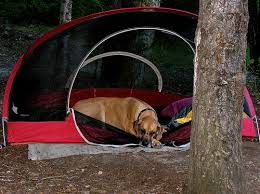
You might consider purchasing a set of Ruff Wear Bark’n boots for your pooch. Especially if you’ll be traveling on rough or rocky terrain, or hiking long distances, you’ll want to make sure your pup’s paws are protected. If your dog is trained to spend his nights in a crate, he’ll take well to having his own tent. The Instent Dog Haus is a convenient and affordable option.
You should have the following items in your pack:
-A canine 1st aid kit. Most of the items this kind of kit similar to what one might find in a human first aid kit, but they include instructions and items that are especially useful for dogs.
-Dog coat or sweater--Especially if you have a short-haired dog, keep in mind that even in the summer it can get extremely cold at night.
-Plenty of the dog food your pup is used to (enough for two or three days longer than you intend to stay) and fresh water.
-An airtight container for your dog’s food so it doesn’t attract wild animals or get contaminated with moisture or creepy critters.
-Collapsible food and water bowls—they pack much better than regular bowls and are lighter.
-An extra collar and leash—you never know what could get broken or chewed. An extra leash also doubles as added length to your current leash, a tourniquet, or rope.
-A current picture of your dog, with a written description on the back including unique markings. This will be good to have if your dog gets lost.
-A comb to help remove burrs and bugs from your dog’s fur.
-Baggies to pick up after your dog. Biodegradable bags are available, so there’s no excuse to not clean up!
-Current records of your dog’s health and vaccinations.
Now you’re Camping!
Never let your dog out of your sight or your site. There are all kinds of trouble your precocious pup can get into in the woods, from wild animals to other campers; the best way to avoid this trouble is to keep your pooch by your side and on a leash. Never, ever let your dog chase wildlife. It might seem like harmless fun to let your dog run after a seemingly gentle animal like a deer, but one well-placed kick from those graceful creatures can be the end of your beloved dog. Not to mention that whenever camping, with your dog or not, it is important not to disturb the natural environment, which includes the wildlife.
If your camping trip includes a long hike to the site, or if hiking is part of your itinerary, be considerate of your dog’s limits. By the time your dog refuses to go any further, he has been too exhausted for too long. Take plenty of breaks for water and rest and check his paws often for cuts, scrapes, thorns, and burrs. Do a thorough tick check on yourself, your family, and your dog at the end of each day.
Remember that every traveler with a dog is an ambassador for dog owners everywhere. Set a good example, be a contentious dog owner, and maybe, one day, more sites will allow dogs. Always, ALWAYS pick up after your dog! Dog waste spreads disease, attracts pests, and is an icky inconvenience to other campers. Every dog owner who doesn’t clean up after their pup is one step closer to your favorite site being closed to dogs. Carefully store any left-over dog food where it won’t attract pests or wild animals. Your camping neighbors will not be pleased when a bear lumbers into the area in search of your dog’s kibble. If your neighbors are not amused by your dog’s antics or just the presence of your dog in general, just move. It is much easier to set up camp elsewhere than to spend your camping trip with a combative neighbor. Those of us who choose to camp with our dogs are, unfortunately, the minority, and because of irresponsible, inconsiderate dog owners, in many places we have been given a bad name. Do your very best to show the world that camping and dogs go beautifully hand in hand… because they do!
Saturday, March 27, 2010
Camping with Your Dog
Emergencies & Your Dog
Picture this—you’re relaxing on your couch with your pooch after dinner, watching TV, and your favorite sitcom is interrupted by an emergency announcement. Your town is suddenly, and without warning, being evacuated. What do you do? Where will you go? What’s the plan? You and your trusty hound exchange wide-eyed looks as a thousand possibilities and fears race through your mind.
If you are properly prepared for an emergency, then that moment, though stressful, would be followed by a series of calm and calculated actions, each one simple and planned, resulting in a much less terrifying and hectic situation, not to mention the assurance of safety for you and your beloved dog. If you aren’t ready when you hear such an emergency announcement, the chances that you, running anxious around the house, will find and pack everything you need and make the right decisions, are slim to none.
So Get Ready
First, sit down and make a list of phone numbers. Write down the numbers of your vet, a local 24 hour emergency vet, poison control, local animal control, local humane society or SPCA, and the numbers of a few vets and a 24 hour emergency vets in surrounding cities in the event that you have to evacuate. Public shelters usually do not accept dogs (except for service dogs) so you need to find out ahead of time where else you could go. Call local hotels and hotels in surrounding cities, enquire about their policies regarding animals and emergency situations, and be sure to mention the number of dogs you’ll have and their breeds. Some hotels will let in small dogs but not large ones, and restrict certain breeds; so “do you allow dogs” is not a sufficient question. Add the numbers of dog-friendly hotels to your list. Write a note on the bottom of the list including your dog’s feeding schedule, any specific health issues, and instructions for when and how to give your dog any medication he may take on a daily basis. Make three copies of this list, and post one copy by your phone, put one in your emergency kit, and fold one up and put it in your wallet.
Whatever the nature of an emergency, whether it’s a snowstorm that keeps you from getting home from work or a hurricane forcing you to evacuate from your town, it is extremely helpful to have a buddy who can attend to your dog if you can’t. A trusted neighbor, friend or family member who lives close-by can look in on your dog if you can’t make it home, and can evacuate your pets if you’re not around. Make sure that the person you choose is familiar with your dog and his habits. If he tends to hide under the bed when he’s scared, or has one toy that will always, always make him come running when you squeak it, your buddy needs to know. Make sure your buddy is willing to take care of and travel with your dog if you can’t. Because of this, your buddy should probably not be someone who already has several animals or small children to deal with. Show your buddy where you keep your emergency supplies and where you have posted your list of emergency numbers, and give them a key to your house. Make arrangements with your buddy concerning where you will meet up in an emergency. Establish one close-by location, and one farther away so you know where you can find your dog if even if you can’t reach your buddy via cell phone. You should also make arrangements with a friend with a dog-friendly home who’s far enough away to not be affected by an evacuation or natural disaster with whom you could stay if you have to evacuate.
Place a sticker on or near your front door and on the window nearest to your dog’s crate that states how many and what kind of dog is in the house. This will alert emergency personnel, and if something happens to you and your buddy they will remove the dog from the house. If you evacuate with your pet, make sure to take these stickers down or write “evacuated with pets” over them so vital time is not wasted on dogs that don’t need saving.
Your Emergency Kit
An emergency kit is absolutely necessary. In certain situations these items can mean life or death for your dog, and if nothing else, they will make everything a lot easier and more comfortable for everyone involved.
3-5 days-worth of dog food in an airtight container—the trick to not being stuck with stale food: check the expiration date and mark it on your calendar. Before the food expires, remove it from your kit, replace it with new food, and feed your dog the old food before it has a chance to go bad. If you consistently roll over the food in the kit, you will be reminded to check the expiration dates on medications and other items as well so you know your kit will be ready when you need it.
3-5 days-worth of water—this is the water just for your dog, don’t assume that the water you have set aside for you and your family will be sufficient to share. Don’t forget that bottled water expires too.
Any medicine dog is taking—remember to keep expiration dates in mind.
Collapsible food and water containers—they pack better and are lighter than regular bowls.
Your dog’s medical and vaccination records and copies of registration information in a sealed plastic bag with extra ID tags and an ID tag with an out-of-the-area contact in case your dog loses his collar.
An extra sturdy collar and leash—the collar or leash you use on a daily basis could get lost, broken, or chewed, and you don’t want to be left without a way to restrain your dog.
Flashlight—you should have a flashlight (with working batteries, don't forget to check) in every bag you pack. So many different emergencies result in power outages. Have you ever tried looking for a flashlight in the dark without a flashlight?
Towels—they can be used as bedding, rolled up to make pillows, torn into strips for tourniquets, bandages or rope, and of course, they’re good for wiping down a muddy pup.
Paper towels, trash bags, dog waste bags, and household chlorine bleach—it is absolutely necessary that you clean up after your pet, especially if you are in a public area.
Your list of vets, hotels and emergency 24 hour numbers.
A picture of you with your dog—having your picture with your dog is important, it can help you establish ownership if you get separated. On the back of the picture write your pet’s breed, age, sex, color, and distinguishing characteristics.
A few familiar toys and tasty treats—just like for you, something familiar and pleasant in a scary situation can make a big difference.
A portable crate—it should be big enough to allow your dog to stand, lie down, and turn around comfortably.
Grooming items—if you have a short-haired dog like a Beagle or Lab, this isn’t completely necessary, but if you have an Afghan hound or Pekingese, it’s a good idea to have a comb to keep mats from developing in the fur.
A first aid kit including:
Antiseptic, Hand Sanitizer, Alcohol Cleansing Pads, Scissors, Latex Gloves, Cotton Swabs, Gauze Roll, Instant Cold Compress, Gauze Dressing Pads, Self-Adhesive Vet Wrap, Tweezers w/Magnifying Glass, Syringe for dosing medications, Pet Waste Bags, Buffered Aspirin, Generic Benadryl, Hydrocortisone Cream, Splints, Eye Wash, Petroleum Jelly, and Triple Antibiotic Ointment.
Stay Calm
Now, think back to sitting on the couch. A harried reporter has just explained that at the moment, evacuation is voluntary, but suggested. Just leave, and take your dog with you. Never leave your dog behind! (If you somehow, absolutely must, DO NOT chain or cage the dog, this could be a death sentence). A situation that is dangerous for you is dangerous for your dog too, and it is better to be safe than sorry. If you leave before evacuation is mandatory, you will beat traffic and avoid the panic and fear that tends to result from that sort of situation.
You are prepared, so all you have to do is take a deep breath, put your dog’s crate and your emergency bag in the car and be on your way. From the car you can call your buddy and let him or her know that you have your dog, and make reservations at a hotel or call your further-away buddy and let them know you’re coming. That’s it. Because you were ready, what could have been terrifying and drawn-out took five minutes and you and your precious pooch are already well on your way to safety.
Whether you are at a public shelter, hotel, or friend’s house, keep your dog on a leash. The last thing you need in a stressful situation is to run after Fido as he chases a squirrel down the street.
If you decide to stay home, establish a safe room. This should be an interior room in the house, preferably without any windows (depending on the nature of the emergency). Put your emergency bag and your dog’s crate in the room and bring in a TV and radio to keep up with what’s going on and when it’s safe to come out of your house. Make sure that anything you might need is in the room so you don’t have to leave if the situation gets bad.
When you return home after an emergency, keep your dog leashed. Familiar smells and land marks might be gone, disorienting your dog, and other dangers like fallen trees or injured animals could be anywhere. Remember to be patient with your dog after such an emergency, he does not understand what has happened, and is only reacting to the stress of the situation. Try to get your dog back to his normal routine as soon as possible; this will help him bounce back faster.
Choosing the Right Breed
Whether the kids finally wore you down, or you’ve finally moved into a pet-friendly home; whether you’ve recently lost your beloved best furry friend, or you’re out on your own for the first time and want a four-legged companion, choosing the breed of dog that’s right for you is an important decision, and is not to be taken lightly.
The first thing to consider is whether you and your family are really ready for a dog. Especially if you intend to get a puppy, everyone in the home must realize that they require constant supervision, care, and attention. The only low-energy puppy is an unhealthy puppy. “But it’s not my dog!” is never an acceptable attitude. Everyone has to agree that they are up for the challenge of caring for a puppy and maintaining consistency.
Once everyone in the home is on board, there are many factors to consider that will help you pick the perfect breed. First, think about why you want a dog. Are you looking for a running partner or a lap dog; are you seeking a protector or a shopping buddy; do you need help keeping your livestock in check or do you want a friend for your children to grow up with? Every kind of dog was bred with a specific purpose, and a dog fulfilling this purpose is a happy dog. One who is looking for a loyal protector should consider a German Shepherd, a Bouvier des Flandres or an
Next, you have to think about energy level, exercise needs and environment. If you chose an intense and high energy dog, but prefer a sedentary lifestyle, you and your new friend will be unhappy. Do not get a high energy dog in hopes that he will force you into a workout routine. You will have whatever dog you choose for the next 8 to 18 years, depending on the breed, and if you haven’t already started running or jogging, it isn’t fair to commit to a dog who requires that kind of activity. Furthermore, if you live in an apartment, or just don’t have a yard, you should look for a dog who is lower-energy and content to just hang around. Apartment life, however, does not mean you can’t have a dog who needs a lot of exercise, if you have a dog park nearby and are up to the duty of long daily walks. If you have acres for your dog to wander, though, a high energy dog will be much happier. Dogs who would be especially content to be your couch buddy include Bulldogs, Mastiffs, and Pekingese. Keep in mind, however, that some low energy dogs are not so great to raise with children because they may grow impatient with constant commotion. Dogs who require a lot of exercise are fun for kids, but are a big commitment; some of these breeds include Siberian Huskies, German Short Haired Pointers, and English Springer Spaniels.
How much free time do you have to dedicate to the new addition to your family? This is an issue as far as energy level and ease of training. Of course, a high energy dog will require much more of your time for a couple of daily walks and lots of games of fetch and Frisbee. Some dogs are much more easily trained than others as well. Labradors, Yorkies, and Old English Sheepdogs are among the breeds who are especially eager to please and can learn tricks like “paw” in as little as ten minutes; they make wonderful first dogs. Other breeds require a huge amount of time, consistency, and commitment to housebreak and train, but if you’re up to it, make great companions. Some of these breeds include Beagles, Schipperkes, and Afghan Hounds. If you’ve never owned or trained a dog, these more independent, strong-willed breeds are significantly more challenging.
Another consideration as far as time and maintenance is grooming. Dogs like Irish Setters, Maltese, and Airedales require almost constant upkeep to maintain their beautiful coats. Short-haired breeds like Boxers, Basset Hounds, and Whippets require the occasional brush and bath, but are otherwise self-sufficient.
Do you have other pets? Some breeds have a highly developed prey drive and if you have other animals in the home, especially rodents, certain breeds will try to fetch them and present them to you as a gift. Greyhounds, terrier breeds, and retrievers are likely to display this behavior. However, any dog who is well socialized with other animals at a young age can learn to live with your other dog, cat, or even ferret or rabbit. Keep in mind that conditioning a more prey-driven breed to live with small animals is time consuming and requires dedication.
Is your dream dog a snuggle bug, or would you prefer a dog who likes to keep more to himself? Is your dog going to be by your side the majority of the time, or is he going to spend a lot of time alone? Some especially affectionate breeds who prefer to be with you as much as possible include the Newfoundland, the Otterhound, and the American Cocker Spaniel. Shar-Pei, Keeshonds, and Shiba Inu are more content with their alone time.
Are shedding or allergies an issue for you? Some people don’t mind vacuuming and having a lint roller on hand at all times, and others can’t be bothered, or have allergies which limit the amount of dander they can handle in the house. Those who can’t stand dog hair should stay away from Saint Bernards, Akitas, and Collies, and look towards Schnauzers, Basenjis, and the Chinese Crested.
What about expense? If you are on an extremely tight budget, remember that a big dog can eat like a horse. Small dogs will go through less food, and usually products for dogs such as clothing, crates, collars and beds are priced based on size. If you aren’t sure that you will be able to provide a constant supply of food, do not get a dog. But, if you are looking for a less expensive option than a Great Dane or Malamute, which can eat 5-8 cups of food every day, think about a miniature or toy breed, which will only eat up to 2 cups a day.
Remember that dogs are just like people, we inherit many physical features and aspects of our disposition from our parents, but we are all individuals too. There are aggressive Labs, energetic Bulldogs, and timid Rottweilers because every dog has a different personality, and so much of how dogs behave is a result of how they are raised, socialized, and trained. Use these ideas about choosing the right breed as a guideline, try to put out of your head picking a particular breed just because it is popular or cute, and don’t forget that proper care, training, and attention are important no matter what breed you choose.
Help! I Lost My Dog
t’s a beautiful afternoon, so you and your beloved dog are hanging out in your fenced-in back yard. You’re pulling weeds in the flower bed, and Rover is sniffing around the yard, looking for something to get into. After a while, by the heat of the midday sun, you’re reminded that you and Rover should both probably have some water, so you turn towards the house, calling your dog. But he doesn’t come. You call again, and there’s no dog in sight. Then you scream, your voice cracking, “Rover! Rover come!!!” But still there’s nothing. It seems as if Rover has disappeared into thin air, and panic begins to set in. What do you do?
Right Away
Take a deep breath; try to calm yourself so you can be as efficient and methodical as possible. Head out into the neighborhood. Does your dog have a pooch friend at a neighbor’s house, or a nearby park where he likes to run around? Check those places first. Take a bag or pocket full of your dog’s favorite treats and a picture of your dog. If he has a favorite toy, especially one that makes noise, bring that too. Also, bring a flash light, even if it is broad daylight, for checking dark nooks and crannies around the neighborhood. If your dog has a pooch sibling, leash your other dog and bring him or her along; this might help coax your dog out. If you get together with friends to let all your dogs play, have them bring their dogs out too; your dog won’t want to miss out on a chance to play with his friends.
Don’t waste any time, and try to cover as much ground as you can in as short an amount of time as possible. Call your local friends, neighbors and family to help you search, and try to be as organized as possible. Fan out, but do so in groups of at least two so everyone is safe. In the first two hours after your dog has disappeared, try to cover a two mile radius around where your dog was last seen. Be as noisy as possible, but don’t call your dog with your stern voice. Use your happy, fun-time voice as if everything is ok and you’re just trying to get your dog to come out and play. From time to time, as you call for your dog, stop and listen carefully. If your dog is stuck or hurt somewhere, he might respond to your calls with a bark, howl, or whimper.
While you’re searching, have a friend posted at your house in case he comes home; make sure someone searches your property carefully. Your dog could have shimmied his way into a storm drain, crawl space, or other tight, dark spot and gotten stuck. Have another friend call the local shelters, rescues, vets, animal control and police to let them know that your dog is lost. Have them offer a detailed description of your dog, including breed, age, sex, unique markings, health conditions, and anything else that makes your dog special. If you live near a county line, call the respective organizations in your neighboring county. Chances are, this early in the game, your dog probably hasn’t ended up at a shelter yet. However, letting local humane societies and rescue organizations know who you are and what your dog looks like before he shows up is important. If he does end up at a shelter, they’ll know he is a wanted, cared-for family pet and will keep him safe until they can reach you.
Show everyone you come across the picture of your dog and ask them if they’ll help you look. Kids are great for this kind of search, but try to talk to large groups or kids with their parents. Children are raised to be weary of the “help me look for my lost puppy” ploy. Put them at ease by asking them if they would mind getting their parents to help look too, or if they could just continue playing where they are and keep their eyes open for Rover.
After Sunset
As it gets too dark to further pursue your search, head home. Put your dog’s bed, some favorite toys and a few articles of clothing you have recently worn outside. Your dog might be drawn-in by the familiarity and comfort. If your neighborhood has a crime watch, call and describe your dog. Ask who’s on duty for the night and if they would mind keeping an eye out for Rover. Then, make a lost dog flyer. Include a color picture of your dog with a written description. Include where and when your dog was lost, his breed, sex, age, weight, color, some specific markings, and your phone number. Do not include a complete description of your dog’s unique markings. You will need to make sure that people who call and say they have your dog are telling the truth; so if your dog has all white feet with one black spot, leave that out for later identification.
If your dog is female, be sure to mention that she is spayed, even if she isn’t. This will dissuade dog thieves from being tempted to use her for breeding. Also mention that your dog is a “family pet.” First of all, this garners sympathy, and implies that your dog is healthy and well cared-for. Furthermore, mention of the fact that your dog is a show dog or something else that sounds fancy might encourage uncaring opportunists to either keep your dog or try to blackmail you for a huge reward. Do state that a reward will be provided for the safe return of your dog, but do not specify an amount. Include your phone number, but leave out your name and address for your own safety.
Make at least 200 copies of these flyers and place them at gas stations, on bulletin boards, at grocery stores, on poles by stop lights (where people will have time to read them) and anywhere there’s heavy foot traffic.
Place an ad in the newspaper as well.
As Time Goes By
Over the next couple of days, get your friends to help you rotate through all the local rescues, shelters, and humane societies. Take some flyers and ask if they will hang them up. Visit shelters further away than you might assume your dog has traveled. If someone picked your dog up, they may have driven him to the closest shelter of which they are aware, which could be further than you think. You or one of your friends should visit every local shelter every day. Do not rely on shelters to identify your dog, especially if he doesn’t have any remarkable markings. Also, if your dog is a specific breed, inquire with area rescues for that breed. Don’t forget to call local vets and emergency vets to see if anyone’s brought your dog there.
Read the dog found ads in the paper every day, and follow every lead that could possibly be your dog. It is better to build false hopes than to miss the chance to reclaim your dog out of fear of doing so. You can also register your dog with an online organization like Fido Finder, Pets911, or another dog lost and found website. For a fee, some sites will even call around to help you look for your dog.
It is a sad prospect, but you should also call the local Department of Transportation and Animal Control and ask if any dogs fitting your dog’s description have been killed on the roads since your dog went missing. This is a difficult phone call to make, and you might be told something you don’t want to hear, but at least you’ll know. If your dog has passed away, in the long run, it is better to know the truth so you can move on than it is to forever wonder if Rover might come back.
When you receive calls from people saying they found your dog, be weary. There are many bad people out there looking to take advantage of the vulnerable. Ask them questions they couldn’t possibly answer unless they’re looking right at your dog, and make sure they can’t be answered by looking at the picture on your flyer. If the story rings true, arrange to meet this person in a public place and bring a friend. Just because this stranger has your dog doesn’t mean they are safe to meet privately.
Bear in mind that a common scam consists of someone calling from another state saying they found your dog, then asking for money to pay to send him home. A few carefully chosen questions about your dog should flush out these scammers.
Once you find your dog, don’t forget to take the flyers down.
Puppy Proofing Your Home
here’s a lot to think about when you’re preparing for a new dog. There are many decisions and many preparations to be made. One of the most important things you can do for your new dog is make sure that your home is as safe as possible. We would all like to think that we can be completely attentive to Rover at all times; that he won’t get out of our sights, and we’ll be able to keep him out of trouble. The truth, however, is that Rover can sneak off and get into something dangerous before we even notice he’s gone. The best way to keep your pooch safe is to make sure your home is thoroughly puppy proofed.
Dogs and puppies do not have the luxury of hands to help them explore new environments, so they use their mouths. To get ready for a new puppy, use the same principal you would to prepare for a two year old in your home—If it fits in their mouth, they will probably try to put it there. Puppies can get into anything a toddler can, and more because some puppies are truly adept climbers. My Beagle can not only jump on the counters directly from the ground, he can also climb all the way to the top of the refrigerator.
All around the House
The first thing you can do to get an idea about what needs to change in your home to prepare for a new dog is get on “all fours”. It may seem silly, but this dog’s-eye-view will help you anticipate a lot of the doggie dangers in your house. In each room of your home, look from doggie-level for electrical cords, which should be tied out of the way, or run under covers along the corners of the room. Some dogs are eager to chew cords, and even if they don’t chew them, an excited dog running along can get tangled in cords and pull heavy machinery like TVs and DVD players down on top of them. From dog level, you can also see if there are any loose nails sticking out of walls or furniture that could catch a puppy as he runs by. Also, look for puppy-sized hiding places that can lead to trouble. Make sure you block access to the spaces behind your fridge, your washer and dryer, and behind any other machinery or large furniture. Dogs can get tangled in cords, can access dangerous heating elements, can get stuck, and sometimes will just hide out of reach. Make sure there are covers on all your air vents so little puppies can’t fall in or go exploring. From this low vantage point, you can also see if you have any houseplants within doggie reach. Many ornamental houseplants, including holly, irises, ivy, Easter lilies, oleander, and poinsettias (among many, many others) are poisonous to dogs. Consider removing these decorative plants from your home until your puppy is out of his chewing stage, or place them in hanging baskets out of reach.
Kitchen
As previously mentioned, it’s best to assume your dog is a truly talented climber, because you never know what he might be able to get into when you aren’t looking. Child locks are available anywhere that home supplies are sold, including most grocery stores. They are easy to install and inexpensive, so there’s no reason not to have them on every cabinet. Sure, placing child locks on the cabinets above the fridge is a little excessive if you have a Labrador or German Shepherd, but if you have a Beagle or other small, agile, problem-solving breed, access to these areas is fully within the realm of possibility. No matter what breed of dog you have, you should definitely have child locks on the cabinet under the sink if you store any kind of household chemicals therein. It’s ok to store the bleach, ammonia, and other cleaning products in your kitchen, as long as they are behind a sturdy child-locked cabinet door, and you are confident Rover won’t be able to break in.
You must also be mindful about leaving food out. Not only are foods like chocolate, chicken bones, onions, grapes and many more dangerous for your dog, but food on the counters also encourages counter surfing. When your dog jumps up on the counters and finds food, this is called a self rewarding behavior, which is extremely hard to train away. Most of us train our dogs with rewards, so if their bad behavior results in a delicious reward, how do we counteract that?
Also, make sure your trash can has a tight fitting lid or is in a closet or cabinet with a sturdy door. Dogs follow their nose to the yummy smells of last night’s leftovers in the garbage can, and can make a huge mess and make themselves sick if they get into the trash. A dog left to his own devices will eat every bit of foodstuff in the garbage, much of which can be poisonous, and all that eating can also result in a dangerous condition called Bloat. A small trash can under the sink behind a child lock is your best bet. These trash cans fill up fast, encouraging you to keep up with taking out the trash, which leaves less danger and temptation for your pooch. If you have a small dog like a Chihuahua, or a Yorkie, a large trash can with a tight lid will suffice, but owners of Great Danes, Poodles and other large dogs should consider the under-the cabinet method. I keep my trash can on top of my washing machine behind a large sliding door, and my Beagle gets closer every day to figuring out how to get to it.
Bathroom
The bathroom is another room in which child locks come in handy. If you store cleaning supplies or other chemical products under your bathroom sink, you should absolutely secure it shut with a child lock. You should also consider the climbing opportunities a bathroom offers. Think how easy it would be for a dog to jump on the toilet, jump from there to the sink, and from there, raid your medicine cabinet. Depending on your breed of dog, this may be more likely than you think. The plastic of pill bottles is satisfying to chew and they make enticing noises as the pills rattle about inside. Cut your dog off from this dangerous temptation with a child lock on your medicine cabinet door.
Also, it’s important to keep all toiletries and make up out of your dog’s reach. It is extremely convenient to keep the makeup and lotions you use every morning out on the sink, but they are too tempting for your dog. Maintain the convenience by having one small bag with your everyday necessities stashed in your locked medicine cabinet.
Toilet bowls are extremely tempting to dogs. They are a water bowl that is always full and a fun place to splash around and play. They are also a prime environment for bacterial growth, can hold dangerous chemicals, and can even be a drowning hazard. You should make sure that you and the rest of your family always keep the toilet lid shut. Just in case you forget, don’t use any of the in-tank style cleaners that keep chemicals in your toilet bowl. The best way to keep your pet out of trouble in the bathroom is to make it a habit to keep the bathroom door shut all-together.
Living Room and Bedroom
It may be nice for entertaining to have a candy dish or dish of mixed nuts out on your coffee table, but this is a huge hazard for your dog. Chocolate and macadamia nuts are both poisonous to dogs.
You also need to consider the fact that excited tails and knick knacks do not mix. This is another time when getting on all fours is beneficial. Any vases, lamps, and various knick knacks that are around tail height should be relocated to high shelves.
Crafty folks should take a look at their crafting areas and make sure that no trouble can be found there by a curious pup. Sewing kits are full of tempting, highly chewable spools of thread and dangerously small and sharp pins and needles. Also, many paints, glues, and other craft products can make your dog sick if ingested. Consider storing all your craft stuffs in large plastic tubs with secured tops, or in closets behind closed doors.
Those with children must be conscious of the chewability, and choking hazards associated with children’s toys. Make sure your kids keep their toys picked up, or that toys stay in children’s rooms behind closed doors.
Enticing, chewable possessions like shoes and belts should be kept put-away in closets out of puppies reach, or those expensive leather loafers will be one of Rovers new favorite toys before you know it.
The Garage
The safest plan as far as the garage is concerned is to make it off-limits to your dog. This is where most people store all kinds of dangerous products like motor oil, antifreeze, moth balls, cleaners, fertilizers, and pesticides. There are many dog, and generally environmentally safe products with which you can replace your fertilizers, cleaners, and pesticides. Nematodes spread on your lawn will kill fleas, and Nature’s Miracle Power Spray works as well, if not better, than dangerous chemical cleaners. However, you still have to worry about antifreeze, which has a sweet taste and smell that appeals to dogs, as well as sharp and dangerous tools and all sorts of other trouble your dog may find in the garage. It’s best to just never let your puppy in the garage without supervision.
In general, the best way to keep your pooch out of trouble at home is to make sure your house is neat, tidy, and uncluttered. Remember that no matter how well you puppy proof, puppies are curious, small and often quite agile, so constant supervision is still a must!
Dog Toy Maintenance
Dog toys are not just a luxury for your dog, they are necessary. They help fight boredom and separation anxiety, they help your dog get the exercise he needs, they are a good replacement for improper behavior, and they are fun! However, you have to keep an eye on your dog’s toys so they do not become hazardous to your dog’s health.
Make it a habit to keep all your dog’s toys in one place, so you can periodically examine them for wear and cleanliness. You can even teach your dog a “put your toys away” command, which is a fun way for you and your dog to tidy the house together. A dog Toy Box is great for this.
Toys to Toss
Regularly inspect your dog’s toys for signs of excessive wear. Any toys which are significantly smaller than they were when they were new should be thrown out, as should any toys which your dog has been obviously eating. Stuffed toys that have been ripped apart should be thrown out, as should toys with dangling string or small parts. Toys with an especially foul odor, even after washing in hot water should be tossed as well.
Cleaning Nylon and Rubber Toys
You can use a Toy Cleaning Brush or old toothbrush to remove excess grime from nylon and rubber toys, and you can wash them by hand with dish soap and hot water. You can also throw these toys in the dishwasher on the hottest cycle with no detergent. The hot water and pressure will remove grime and sterilize the toy. Check the toy’s packaging, or contact the manufacturer to be sure it is safe to wash in the dishwasher.
Cleaning Stuffable Toys
Your dog’s Kongs and other stuffable toys should be washed after every time you stuff them with food. Food particles work their way in to all the nooks and crannies of these toys and can harbor tons of dangerous bacteria. Use dish soap, hot water and a toy cleaning brush or old toothbrush to de-grime your dog’s treat toys. Most of these toys can be washed on the top rack in your dishwasher as well, which will truly sanitize the toy. Check the toy’s packaging, or contact the manufacturer to be sure it is safe to wash in the dishwasher.
Cleaning Soft/Plush Toys
Soft toys, like rope toys can also be put in the dishwasher on the hot cycle. You can sterilize them even more thoroughly by wetting them and putting them in the microwave for a full minute. Be careful removing these toys from the microwave; they will be extremely hot. Again, check the toy’s packaging, or contact the manufacturer to be sure it is safe to wash in the dishwasher or microwave.
Most stuffed animal toys can be put in the washing machine, and some can even be put in the dryer. My personal principle for my dog’s stuffed toys is, if it’s not sturdy enough to hold up in the washer and dryer, it isn’t sturdy enough for my Beagle anyway.
Choosing the Perfect Dog Bed
Dogs seek a comfy place to catch their Z’s just like we do, and often this is at the expense of our good night’s sleep. Purchasing your pooch a bed of his own will help to keep him out of yours, and if you pick a bed that your dog will really use, it will keep him and his hair off the rest of your furniture as well. Even if your dog already stays off the furniture, a bed will get him off the cold, hard floor, help him sleep better and longer, and protect his joints as he ages. A good dog bed will also help keep your large-breed dog from developing unsightly and uncomfortable elbow calluses.
But with all the dog beds on the market today, how do you know which one is right for your pup? There are several factors to consider that will help you find a bed your dog will not only use, but one he will adopt as his favorite comfy spot. To find the perfect bed for your pooch, consider why you’re in the market for a dog bed, how your dog prefers to sleep, your dog’s size, and your dog’s special needs.
Why Does My Dog Need a Bed?
Is your dog always outside? A dog house provides a good amount of necessary shelter from the elements, but even in the height of summer there can be chilly nights. Ensure your dog’s comfort out in the back yard with an outdoor heated dog bed.
Does your dog spend a lot of time in his crate? Crate floors are hard and cold, which doesn’t exactly create the coziest environment. While crate training, use a blanket or towel for doggy’s comfort--There will be accidents and it is a lot easier to take a soiled towel out and throw a new one in than to wait until a bed is washed and dried; or you can use a water-proof mat, which can just be wiped down. Once your pup is accident-free, however, a crate mat is a great way to make his crate feel more like home. Older dogs and thin or especially bony dogs will benefit greatly from a crate bed or mat.
Are you constantly on the road? You can give your dog the same comfort he would have at home with a travel bed. Sure, you can throw any dog bed in the back of your car, but who has space for a big, plush bed when the car’s already packed tight? Travel beds fold or roll up to next to nothing so you can always have a comfy spot and a piece of home handy for your jet-setting hound.
Does your dog just insist on taking over your bed? Are you tired of the wear, tear, and dog hair on your furniture? Don’t worry; there are plenty of options for you.
Observe Your Dog
Take note of where and how your pup most often catches his Z’s. This will be your biggest clue to what kind of bed your dog would most appreciate.
Do you often find your dog laying smack dab in the middle of your pillow? Does he curl up dead-center on couch cushions and comfy chairs? Then a pillow bed is a good choice. Pillow beds come in a variety of shapes and sizes. They are extremely comfortable, especially for the little dog who thinks he’s a little prince. These beds are not so great for dogs with orthopedic issues, as they do not provide much support. They are, however, fantastic for miniature and toy breeds.
Do you tend to wake up to find that your dog has shimmied himself all the way under the covers? Is it not always apparent that the pile of blankets on the couch is actually your carefully concealed canine? Does your pooch live to snuggle? A nest bed is the right fit for your dog. Nest beds offer your dog a warm and snuggly place to burrow without pulling your throws and stealing the blankets from you at night. They offer comfort and security and are perfect for burrowing breeds like Beagles, Dachshunds and Jack Russell Terriers. These beds are a little harder to get into and out of, and are thus not ideal for older or injured dogs.
Does your dog think he’s people? Do you often open your eyes in the morning to see your pooch looking right back at you with his head on your pillow? Does he like to curl up snug in the corner of the couch? When you’re hanging out with him, watching TV, does he like to snuggle right up against you? Your dog needs a bolster bed. These beds have a firm foam or plush rim that your pooch can snuggle-up against or use as a pillow. Bolster beds come in lots of different designs and orthopedic varieties are available for dogs with arthritis, and older and injured dogs. Otherwise, though, they are great for any breed and any size dog.
Have you tried a pillow, bolster, or nest bed before and your dog still preferred the couch? Is it important to you to maintain a clean design aesthetic in your home? Try a furniture bed. These beds are made to look like real couches and beds, just smaller. They are attractive and durable and are raised to keep your dog out of the bugs and dirt on the floor and away from chilly drafts. There is a furniture bed to match any home style and they are sure to only improve the look of your living room. These beds are not suggested for dogs with arthritis or hip problems as they have to jump up to climb in.
Has your older, injured, arthritic, or overweight dog stopped jumping into bed or on the couch? Is your dog suffering from hip dysplasia or other joint issues? Is your dog skinny or bony? An orthopedic bed is ideal for these issues. Orthopedic beds are filled with firm foam made to evenly distribute weight, lessening stress on joints. These beds prevent pressure sores and calluses and eliminate pressure points, stiffness, and soreness. They are easy to climb into and out of which lessens the stress on your ageing dog’s back and hips. Orthopedic beds are marvelous for greyhounds and whippets, working dogs, ageing dogs, and really, any dog.
Does your tiny dog tend to shiver? Does your pooch insist on sleeping directly between you and your partner for the cozy warmth? Try a heated bed. Heated beds come in indoor and outdoor varieties and are ideal for hairless, short haired and small dogs. They are also wonderful for working dogs, and dogs recovering from injury, as the warmth soothes tired joints and muscles.
Is your dog’s favorite spot in the house a cool stretch of tile, or on top of an AC vent? Is your dog always getting overheated? Does your working dog need a cool spot to rest after the daily grind? Does your dog tend to turn his nose up at other dog beds? Try a cooling bed. Many of these beds are filled with water or gel to keep them cool; and others are made of materials that allow plenty of air flow and draw the heat away from your pooch. If your dog is a floor-sleeper and could use a little cushioning without the warmth, a cooling bed is just perfect. These beds are superb for long or thick haired dogs, and breeds that are easily overheated, like the bulldog.
Does your dog take up more space in the bed than you do? Are you forever coming home to see a stretched out, belly up dog on your couch? A mat or pad is ideal for your dog. They provide maximum space to spread out and are perfect for large dogs that like to sprawl. These beds are great for labs and other large dogs. They don’t require any climbing so they are great for older and injured dogs too.
How Do I Measure My Dog For a Bed?
Choosing the right size bed is important. You want to purchase a quality, long-lasting bed, which is a good investment. However, if you chose the wrong size, you’ll have wasted your money because your dog won’t use it.
Don’t even worry about dragging the cloth tape measure out of your sewing kit, you can just use a piece of string to measure your dog, and measure the string when you’re done. Measure your dog when he is lying down. Lay the string along your dog’s back from the tip of his tail to the tip of his nose. Add ten to twelve inches to this length and you will have the necessary length for your dog’s bed. If your dog really likes to stretch out, add another two or four inches.
Other Things to Consider
Does your dog have an uncontrollable urge to roll in the mud? Make sure the bed you purchase has a removable, machine washable cover. Many beds have zip-off covers so they can be easily removed and thrown in the washer. Also consider purchasing a second cover so your dog’s bed is always available, even when one cover is in the wash.
Does your dog scratch and claw at his bed to get the filling in just the right places? He needs a bed with a durable, thick fabric cover; the best being ripstop nylon. Leather beds are cool, comfortable, and long lasting, but not ideal for scratchy dogs.
Is your dog a flopper? Does he enter the room and collapse dramatically onto his bed? Does he dream big, with lots of flailing about? Is your dog’s bed going to sit on tile or hardwood? He should have a bed with a non-skid bottom. This will keep the bed where it belongs and it won’t scoot out from under your dog while he’s chasing rabbits in dream land.
If you take the time to get to know your dog and his sleeping habits, you’ll have no trouble picking out the best bed for your best friend. If your dog is accustomed to sleeping with you, and doesn’t take immediately to his new bed, be patient. Praise him when he lays in it, and put a treat or toy in it at bedtime to encourage him to use it. It’ll only be a matter of time before he figures out that you bought his bed with his best interests in mind.